Thursday, February 28, 2013

Eye on Dacor -The Life of the Kitchen

JC Abbey Introduces Dacor - The Life of the Kitchen
 
A big part of my job as a kitchen designer is to help homeowners select the best appliance for their kitchen. And for that reason I attend tradeshows and manufacturers seminars whenever possible.  Last week I attended a seminar on the Dacor line of products.  What a treat!
 
Dacor is an American, family owned-business that has been operating since 1965 and is well known for its cooking and ventilation products. It offers a full line of appliances that appeal to a broad range of  homeowners because of their style, performance and craftsmanship. When selecting Dacor appliances you have three series to choose between: Distinctive - price point package, Renaissance which gives highlights performance appliances  and Discovery which is more innovative. 
 
 The Discovery 30" Millennia Wall Oven is a jewel in the kitchen and is designed and manufactured in California. I can't say enough about double ovens.  Double ovens are great to have in the kitchen. If you have the space but have to tweak the budget alittle to include one then do it. You won't regret it, I promise.  It's a time saver and if it is a convection oven then it is even more of a time saver.  This one pictured on the right isn't just a gem because it looks pretty but  it's also a "pure convection oven".

Let's talk about this idea of pure convection.  Dacor''s exclusive Pure Convection System  is achieved through a inter workings of 4 parts: fan, heating element, air baffle and the convection filter.  For the homeowner this translate into reduce cooking time, superior heat distribution and it  means  that  you can cook different dishes at the same time without the worry of  the flavors transferring from one dish to another.  It's a baker's delight because as a  pure convection the air circulates around the food so you get even heat distribution meaning  all your cookies will come out looking great; there's no need to turn the pan so that the cookies in the back don't burn.  In the picture on the right you can see the racks and the round filter that I pulled from the back where it is normally kept.  It is dishwasher safe so you can remove it and include it in your next dishwashing cycle.  Another unique feature that I really liked is the space at the front of the rack that allows for a hand to pull the rack out.  So simple a feature, yet so practical.  

Other important features in this oven  are the Controller Panel, the rain gutter and the recessed heating element under the glass.  The rain gutter prevents vapor from descending down the front of the glass on the inside.  There are ovens that no matter how hard you clean that glass the problem is inside the glass so it wll never come clean - the rain gutter prevents that issue.  The recessed heating element under the glass allows for faster preheating and secures that even heating temperature within the oven. 

The Control Panel on this oven is fabulous.  It features a full-color LED display with a glass touch.  It's full color means you can match the paint in your kitchen if you would like.  That sounds funny to some people but the fact is that other people will change the color to use the control panel as an accessory in the kitchen. 

This Control Panel does everything it needs to do: calculate time, temperature and cooking mode.  It also comes with about 100 recipes.  As good as this one is it is undergoing a technological makeover that includes Wi-Fi.  The new  Discovery panel should be out in June of this year.  Just think you can set your temperature and check facebook at the same time.  In my posting on Kitchen Trends I mention that technology in the kitchen will be a hot issue over the few years and then I heard about this panel.  It's exciting. 

As I said Dacor offers a full line of products. If you are thinking of remodeling your kitchen or  maybe just upgrading your appliances do yourself a favor and click on this website:  http://www.dacor.com/.  There's so much more that can be said about this company, its commitment to customer  service and  its well designed products and they offer information, advise and recipes on their website.. 


Monday, February 25, 2013

What size barstool do you need?

So, your kitchen is done and you have a great island that you just can't wait to use.  You need to get those barstools.  Great, what size do you get?  Kitchen designers know this without even thinking because we do it so often. 

* 30" High Countertop
With the Universal Design we often incorporate a 30" high countertop within the kitchen perimeter.  It is the normal  table or desk height and  is often found at the end of the counter or for seating around  the counter.  For this height you just need a  chair or stool with a seat height of 17" or 18".  This is a measurement of the seat to the floor not of the whole length of the chair. 

*  36" High Countertop
Your kitchen counter is normally 36" high that's because the base cabinet is 34 1/2" and the countertop is 1 1/2".  Because we are designing for multi-generational families many kitchens will have varying countertop heights but the 36" high is still the standard height.  For this height a 24" -26" seat  height will be required.

* 42" High Countertop
This is the typical bar countertop height.  For this height a 28"-30" seat height would be required.

Thursday, February 21, 2013

Knobs and Handles

Knobs on Doors except on waste basket cabinets
It's no secret that kitchen remodeling can be overwhelming and very stressful to the homeowners.  The biggest reason probably is because it's s a big interruption in the daily routine of the family.  All of a sudden you are using the dining room table for breakfast and you are using the laundry room sink to wash dishes.  These are things people know about before they remodel, but I find my clients are often surprised at the details involved in a kitchen makeover.  As a designer I am there to help with all the selections - appliances, tile, lighting, as well as cabinets and part of my job is reducing the homeowners stress level.  The one detail that often takes far longer than the homeowner ever expects is the hardware selection for the cabinetry.  If you have a full overlay door style the hardware is necessary to open the doors, otherwise, finger pulls or possibly no hardware at all will work fine. Keep in mind that hardware is jewelry to a cabinet and for this reason people will often add it regardless of necessity. All the doors in these pictures are the full overlay style.

Galley Kitchen - all handles

Once you determine you need/want hardware than the fun of selection begins. Your next decision is what kind - knobs and handles, just knobs, just handles. When people decide on both they tend to put the knobs on the doors and handles (pulls) on the drawers.  The one cabinet that is different is the one with the trash bin, since it pulls out like a drawer, it usually has a handle.  In a small kitchen it is often better to have one or the other but most of my client's prefer all handles (pulls) regardless of the size of their kitchen.


Wider drawer base, larger handle.
If the drawers are over 30" you may want to choose a larger  handle.  Again it depends on you and on your budget.  If you have two handles than you need to pull both at the same time to open the drawer which is the main reason people will choose a larger handle.  However, large handles can be costly which is the main reason a homeowner will go with the two pulls.  Another reason is the look.  One handle will always look more contemporary; two handles have more of a furniture look. 

You're not done with your decisions yet.  You have finish and handle style to think about.  And the prices vary all over the place. Chrome which is coming back in style tends to be the lease espensive whereas oil-rubbed bronze will be a little pricey.  What you choose depends on your appliances, thee look you want to achieve and your budget.  Speaking of budgets, you need to have a budget in mind and tell the designer.  If the designer knows that she won't look for products outside your price range.  If it's important to you then it will be important to her or him.


Details, details - that's why remodeling the kitchen is overwhelming and that's why you should consider hiring a kitchen and bath designer to help you.  It can make a world of difference to your mental health.

Monday, February 18, 2013

In the Woodworker Shop- a 2 person home office.

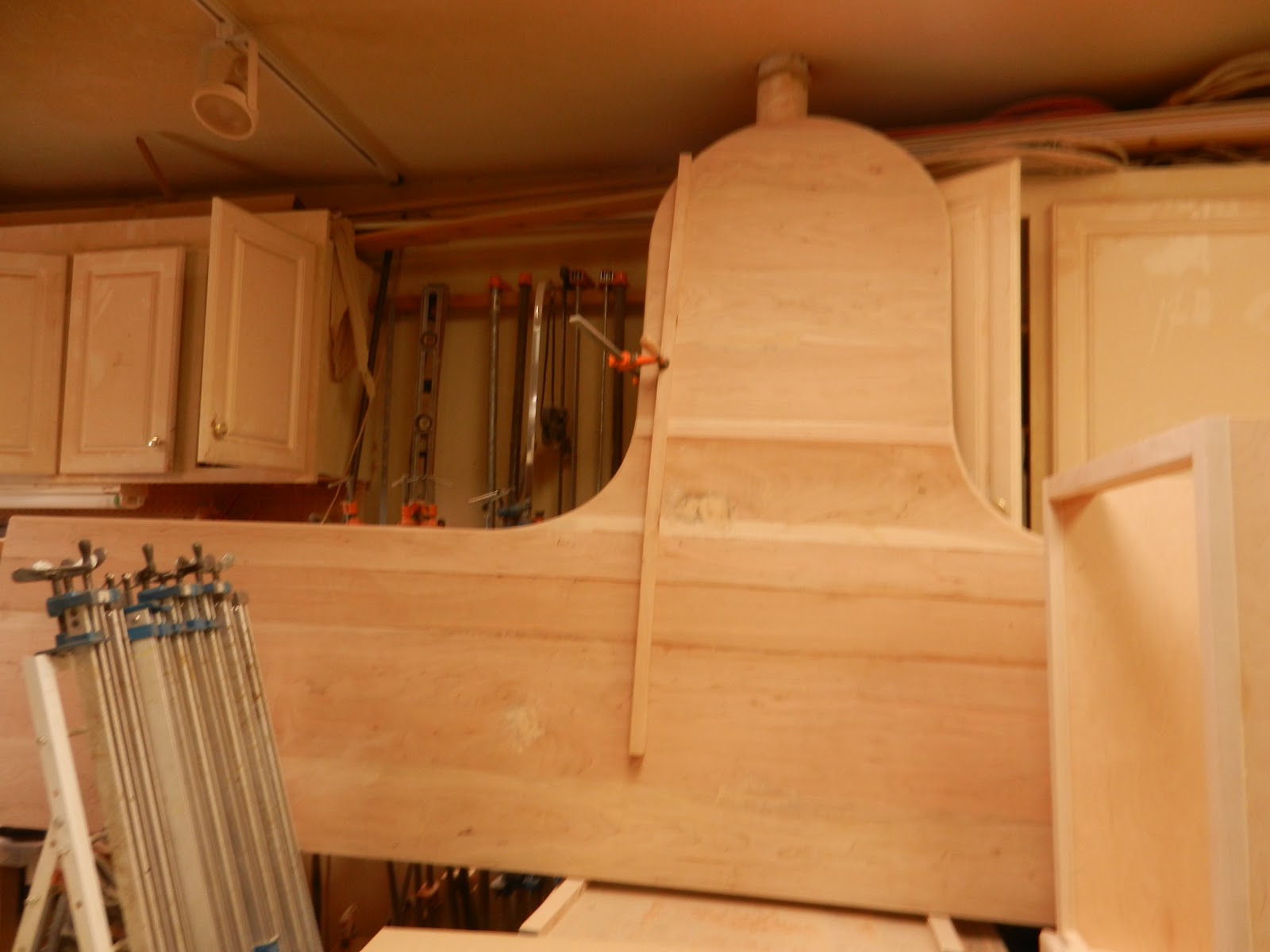
Behind the scenes in the woodworking shop, a two person desk for a home office is on its way to completion.  This past weekend we took a sample door to the clients so they could verify the finish  before the furniture can be completed.   As I work with another client regarding her kitchen, the office is being constructed and the next project which is a loft will commence after this office is installed.  Before any of the construction begins though there are CAD drawings created and presented to the client so that we are all on the same page.  We use the drawings to talk over the design with the client.  Changes can be made up to the time of construction.  A big part of my job other than designing is to make sure it all flow smoothly. 


The Office in Raw Wood, before the stain:

This desk top is 167" and has a rounded desk area for additional counter space. 
The   pedestal will sit beneath the rounded area

Shelf space

pedestal for beneath the desk

Raise panel doors

Thursday, February 14, 2013

At Home in a Hard Hat

As a designer I love to get involved with construction projects and Habitat for Humanities as well as Saint Andrews Catholic Church provided me with the opportunity last weekend.  There's nothing like building a house.  To be working on a team where everyone is progressing towards a common goal and to see the results of your labor in physical form is a fabulous experience.  The future homeowners are also part of the team as they work alongside the volunteers.  With each project there is a Signing ceremony where the homeowners are introduced to all the workers and they share whatever feelings or insights they wish to with the group of volunteers.  After the Signing ceremony you can write your name on one of the 2x4s, then back to work until lunch arrives.

This is a Leed platinum certified home being built in Tempe Arizona http://www.tempe.gov/index.aspx?recordid=1050&page=31.
LEED (Leadership in Energy and Environmental Design) certification means that a construction project uses environmentally friendly building practices and sustainable materials during the new build  or remodeling process.  This home will have solar panels installed on the roof.

When we first arrived for work, there was just a slab of concrete.  By noon most of the frame was up. Life begins early in the construction world.  There's allot to be done.  There were about 30 of us, so instead of nailing lumber my task fell into a more supportive role: carrying lumber, laying vapor lock for the walls, painting, keeping the site clear of debris as we proceed through the process.  It's important to keep the site clear of debris because this is the type of job where safety is paramount.

After the frame is up, the interior work begins.   As a designer my specialties lie in the interior but it is so much fun working on the building process and spending the day outside - as long as the weather is on your side.


Wednesday, February 6, 2013

The Art of Designing with Books

As a designer and a bookwoman I am fascinated by the way people display and care for their books.  As an avid reader and book collector I have more than a 1,000 books in my home, so books and book related issues are always a part of my consciousness.  Over the past few years I've given some away to other readers so that I can, of course, buy more books.  It's an addiction, an obsession, a passion and it's wonderful. 

Book people like seeing their books.  It gives us a feeling of comfort, of warmth and a sense of being home and surrounded by old friends.   We tend to have books  in every room of the house as well as a home library.  If this is the case then you need to decide if you want them to appear as clutter or as decorative art. A wall of books can furnish a room and look like a work of art or it can be a disorganized nightmare.

Regardless of where books are in your home they should be kept our of  harms way.  There are three elements that can damage books: dust, sunlight and moisture. That's why you often find collectibles behind glass doors or wrapped in Mylar.  Another aspect that comes into play is how to estimate shelf size for books.  I prefer 24" wide shelves but as long as you don't go further than 40" you will be fine, but books are heavy so keep that in mind.    As a point of reference you can get about 10 hardback novels on one linear foot of shelf space, oversized hardbacks will yield less and paperbacks about 18 to a linear foot.   If you just want shelves for paperback and trade books only than a 6" to 8" shelf depth works, otherwise a 12" works better.  However, in a office I often  design   13" or  14" depth  shelves depending on the storage needs of the client.  Binders require deeper shelves.

The purpose and shape of every room will dictate how you can display your books in that oom.
 In a large room bookcases can ground the space and add warmth to the room. Bookcases are fabulous because they can store a great deal of books. If the room is too narrow for a bookcase then another option would be to build small, maybe 4", shelves to be used only to display books with fabulous bookcovers placing them with their fronts facing the room similar to placing plates on a plate shelf. Then paint the wall that's behind the shelves a richer color than the rest of the room.  There's all kinds of options but available space is the key.

 In a small room books can be artistically arranged  on an unused surface areas like a built out pony wall.  They can also be arranged on any extra side tables you may have in the room or you can stack them high enough to create their own  table and place a small art object on top.  I would be conscious of creating piles that look appealing, meaning maybe you want piles of the same size or of the same color.  Color is an interesting away to arrange books though not a very functional one.  But as an accent, arranging by color can add drama or jazz to the space because that is what color does.  Another option if you have limited wall space and want a book shelf than you may be able to incorporate bookshelves around the entry door of the room, the window in the room or around the closet door. 

Displaying books randomly around a room is much different than arranging them in a den or a nook dedicated to reading.  In a dedicated area you must decide  how you want to organize your books.  You need a system that best works for you whether it's author within subject or just by subject or by reading date.  Use whatever system works for you and understand that no system is perfect and that  you will still wander around wondering where that book is that you just had in your hand.  It happens.

Arranging books on a bookshelf is an artform.  Take time with this.  It's like hanging pictures on the walls.  Do you like the look of a straight row of books?  This works well in a traditional library.   Do you want to break up the row with pictures or art objects?  Do you want them arranged high to low or by author within subject only?  Do you prefer floating shelves randomly placed around the room?  However, you arrange them just make sure you can get to them.  This is fun but it does take a little time.  If you have collectibles then you may want to go with glass doors, Mylar covers or maybe a climate controlled room.  

If you have any questions please feel free to contact me via my contact page.. In our business we build allot of bookcases for rooms as well as build-ins for those nooks around fireplaces and other places in the room.